National EPA

DRAFT FOR CONSULTATION

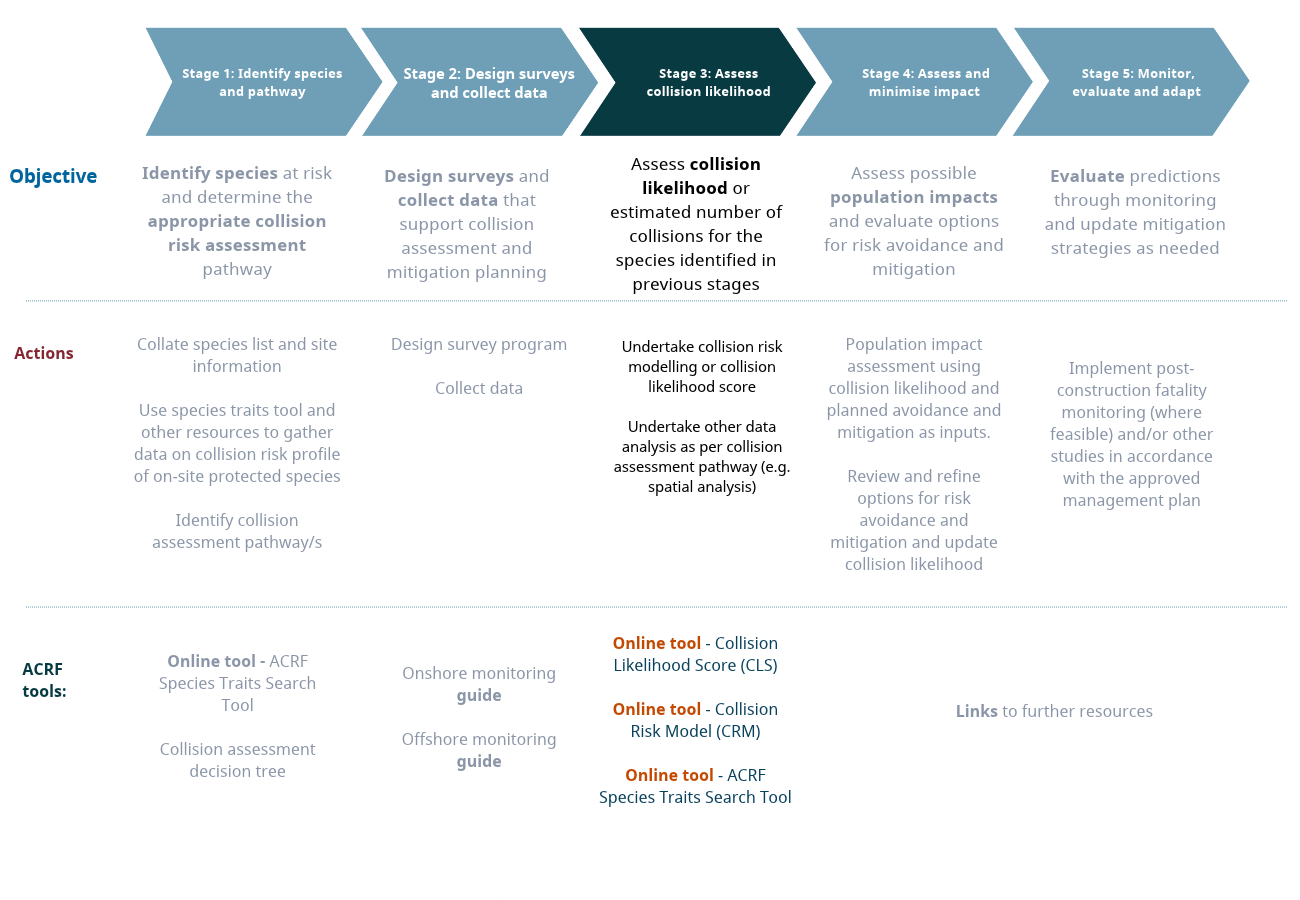
Stage 3: Assess collision likelihood

Stage 3: Assess collision likelihood

Assess collision likelihood or estimated number of collisions for the species identified in previous stages.

Objective and scope

The information collected in Stage 2 should provide the evidence required to assess collision likelihood for species identified in earlier stages or identify any remaining limitations that need to be addressed.

Collision assessment should not be viewed solely as a reporting requirement. Applying the assessment tools while project design remains flexible can help identify high-risk locations, periods or behaviours and provide opportunities to avoid or minimise collision likelihood through project planning, consistent with the mitigation hierarchy.

Stage 3 focuses on assessing collision likelihood using the selected Collision Risk Model (CRM), Collision Likelihood Score (CLS), or hybrid approach. The outputs provide an evidence base for Stage 4, where collision likelihood is considered alongside population and conservation information to assess potential consequences and significance and identify appropriate avoidance and mitigation measures.

Key questions: What is the assessed collision likelihood or predicted annual collision rate for each species of concern? What factors are driving collision likelihood? What avoidance or minimisation opportunities are identified by the assessment? What are the key assumptions uncertainties and limitations?

Spatial scope: Project area and relevant surrounding area, at a scale appropriate to the species, site and assessment pathway.

Project timing: Following collection of sufficient evidence through Stage 2 and during environmental assessment. Stage 3 may be undertaken iteratively as project layouts, mitigation measures, assessment outcomes and relevant new information evolve.

Key Activities:

  • Assess collision likelihood using a CRM, CLS, or hybrid approach.
  • Identify key factors driving collision likelihood and evaluate opportunities for avoidance or minimisation.
  • Document the evidence base, assumptions, uncertainties, and assessment outcomes.
  • Outputs:

  • Collision likelihood assessment: A documented assessment for each species, undertaken using the selected assessment pathway.
  • Assessment results: Collision Risk Model outputs, Collision Likelihood Scores, or other assessment results, as applicable.
  • Interpretation: Interpretation of the results, including the key factors driving collision likelihood and relevant species-specific risk factors.
  • Evidence and uncertainty: The evidence, methods, assumptions, expert judgements, uncertainty and limitations underpinning the assessment.
  • Supplementary analysis: Documentation of targeted or supplementary analyses undertaken to inform the assessment or address key uncertainties.
  • Avoidance and minimisation: Identification of opportunities to avoid or minimise collision likelihood through project design, turbine layout micro-siting, operational measures or other mitigation.
  • Stage 4 inputs: Information suitable to the assessment of population-level consequences and significant in Stage 4.
  • Objective and scope
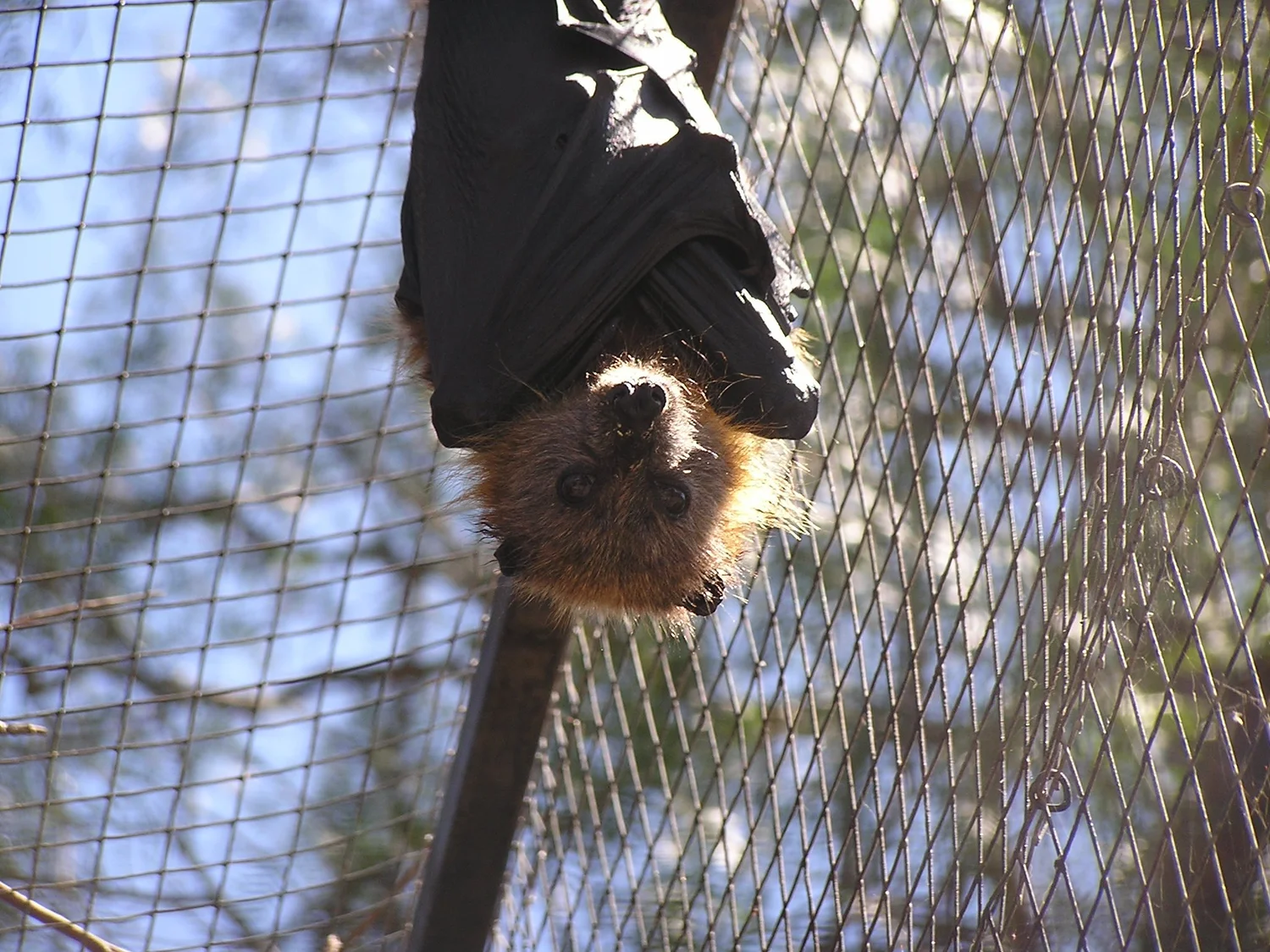
    Photo by Symbolix

    Documents and applications

  • ACRF Guidance document provides detailed information to help navigate this stage and the ACRF as a whole.
  • Collision Likelihood Score (CLS) Self Assessment - A web app for conducting qualitative collision likelihood assessments, providing users with an interactive tool to evaluate potential collision risks based on standardised criteria.
  • ACRF Collision Likelihood Score (CLS) Tool - A web app for calculating the CLS for a specific site. A structured, qualitative assessment of collision likelihood risk using ranked criteria. CLS combines species activity, flight height, seasonal exposure, and collision history to generate transparent risk ratings. CLS is appropriate when data are insufficient for a CRM, during early project stages, or when collision risk is clearly very low or very high.
  • CLS Tool User Guide - A step-by-step guide to using the CLS online tool.
  • Collision Risk Model (CRM) Tool - A simplified non-spatial self assessment tool for quantitative collision risk modelling. The app is based on an open source, peer reviewed R package for more modelling flexibility.
  • CRM Tool User Guide - A step-by-step guide to using the ACRF CRM tool.
  • CRM Methodology - The theoretical foundations and structure of the ACRF CRM tool.
  • Third party resources

  • https://www.collisionrisk.org/ – International resources relating to collision-risk modelling, methods and good practice.
  • collision – An open-source R package implementing a per-turbine stochastic collision-risk model for on-shore and off-shore wind farms. This package is used by the ACRF CRM tool.
  • {stochLAB} An open-source R package implementing a stochastic collision-risk model based on the Band (2012) and Masden (2015) model framework.
  • Other Resources
  • Third party resources
    Photo by Eco Aerial